

"Remember what I was like when you met me?!"
Jorge asked us that on his way out of the clinic, three days after running his first trail half marathon at Silver Falls. He's hooked on trails now and already eyeing a snowshoe race in Bend this winter.
We absolutely remember. Jorge was one of the 35+ runners we worked with after Cherry City in September. He'd spent a year fighting nagging aches and pains that wouldn't go away, the kind that kept getting in the way, and he didn't have a single race on his calendar. Six weeks after his evaluation with Maya, he crossed the finish line at Silver Falls. In his words:
"It almost feels like I've shed a few years and gotten my active lifestyle back."
That's what a finish line does. It hands you a medal, and then it quietly hands you a permission slip for the next hard thing.
The good news? You don't have to have crossed one this year to get yours.
What a Finish Line Permission Slip Actually Is
Finishing something hard changes what feels possible. The half marathon that seemed impossible in January becomes the reason you sign up for a full. The first pain-free 10K becomes the reason you start eyeing trails. Finishing one hard thing has a funny way of making the next one feel possible.
And a "finish line" doesn't have to be a race. It's the first CrossFit comp you actually sign up for. The heavy single you've been chasing for a year. A long hike without paying for it the next day. A full Saturday of yard work, or chasing your kids around the park, without your back filing a complaint.
Whatever yours looks like, the permission slip works the same way.
One Race Weekend, a Whole Stack of Permission Slips
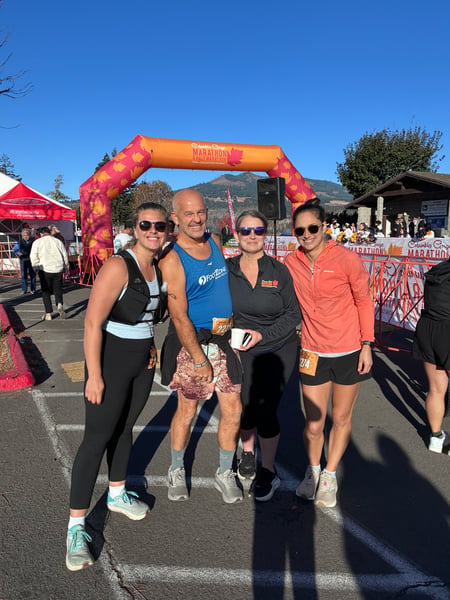
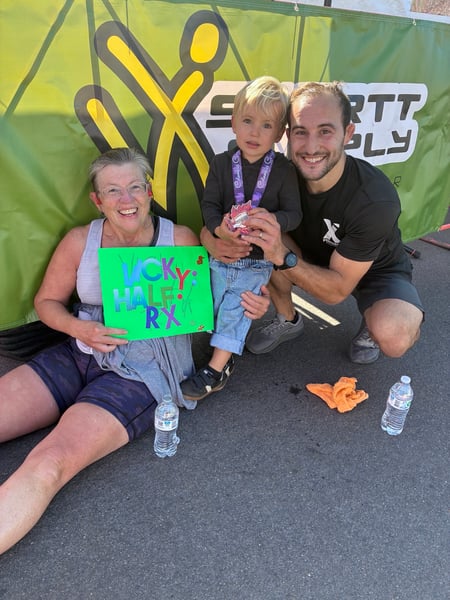
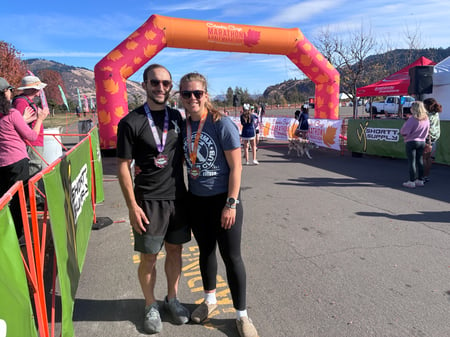
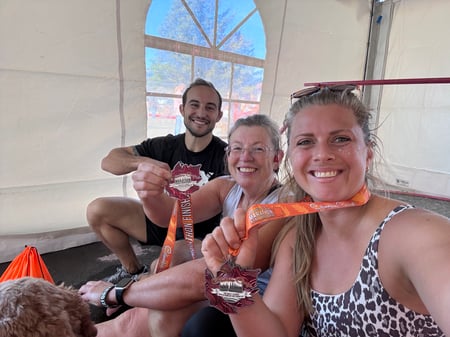
Jorge wasn't the only one with a big weekend. Here's what our clients and the Performx crew got up to this fall:
- Our relay duo split the Columbia Gorge Half for the fifth year in a row. He treated it as a test run for running a full half on his own, and he's already signed up for Corvallis and the full Columbia Gorge Half in 2027. She's been dealing with some acute stuff this year, but nothing was keeping her from that finish line.
- Vicky, our resident running hater, trained all year, crushed her goal, and informed us at the finish line that if we ever ask again, the answer is no.
- Sydney ran her first half marathon ever. Her last attempt ended with Achilles tendinopathy, so this time she worked with Maya and Dalton to get ahead of it before it could bother her. Not a peep.
- Maya ran her first half since 2021 and got back under 8-minute pace (7:41s), chasing her sub-7 days from before kids. She's signed up for the Eugene Half.
- Dr. Emily finished 5th woman in the 10K and is eyeing Eugene too.
- Dalton ran his first marathon. The goal was sub-4. He ran 3:46, then needed an hour to feel like a person again. (Ask anyone who watched him take the stairs that week.)
- Two more of our clients ran the Silver Falls 50K, which is 31 miles of hills. On purpose.
For half the people on that list, race day was a permission slip. Jorge is into trails now. Our relay runner is picking his first full half. Maya and Dr. Emily have Eugene in their sights.
And Vicky? She'd like every runner reading this to come try a CrossFit class. She played your game. Now it's your turn to play hers.
Didn't Get Your Finish Line This Year?
Maybe 2026 didn't give you that moment. Something kept flaring up. You spent the year working around a knee, a shoulder, or a back instead of training through it. Maybe you stopped signing up for things altogether because you didn't trust your body to hold up.
That's usually more fixable than it feels.
Here's why it's worth dealing with now instead of "next season." A systematic review in Sports Medicine found that the main risk factor for a running injury was having had an injury in the previous 12 months. A more recent review in the Journal of Sport and Health Science landed in the same place: for distance runners, a previous running injury was the strongest predictor of the next one. Those studies looked at runners, but we see the same pattern in lifters, CrossFitters, and weekend warriors every week.
In plain English, a nagging injury that won't go away rarely stays in its lane. Left alone, it tends to set up the next one.
Signs Your Nagging Injury Needs More Than Rest
- It's been hanging around for more than a couple of weeks, even after you backed off.
- It fades when you rest, then comes right back when you ramp up again.
- You've started planning your workouts, races, or weekends around it.
- You've tried a few things that helped for a while, but nothing stuck.
The NHS guidance on running injuries recommends getting pain checked by a doctor or physiotherapist when it doesn't settle after easing off, rather than waiting it out. If you're checking two or more boxes above, you're well past that point.
Dealing with it isn't glamorous. But as we wrote in The Hard Part Is the Whole Point, the dread is almost always bigger than the actual thing.
Getting Back to Activity After Injury Starts With What's in the Way
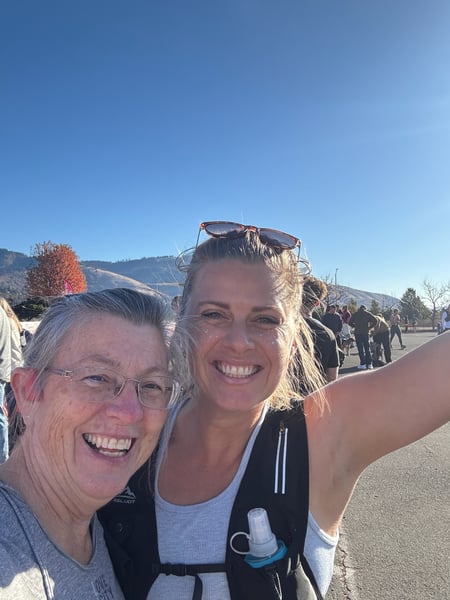
Jorge tried just about everything before he found us: regular PT, acupuncture, PRP. None of those are bad tools. But when the thing driving the pain never gets found, you end up treating the symptom over and over while the cause keeps doing its thing.
That's why every evaluation at Performx starts with the i-3 Model, a framework for finding where your mechanics are breaking down, not just where it hurts. It's the same reason runners who get hurt right before race day are usually solving the wrong problem, and why CrossFit shoulder pain that keeps coming back often isn't really a shoulder problem.
Sydney's story is the flip side of Jorge's. Instead of waiting for her Achilles to flare up again, she worked with Maya and Dalton to get ahead of it before training ramped up. The result: her first half marathon, and not a peep from the Achilles.
Getting back to activity after an injury is a lot easier when you know exactly what you're building around.
How to Choose Your Next Race (or Your Next Hard Thing)
Whether you're riding a finish line high or you're ready to finally stop working around something, here's how we'd pick what's next:
- Pick something that excites you a little. Not the event you think you should do. The one you keep thinking about. Jorge picked snowshoes. Vicky picked "never again." Both are valid.
- Be honest about what's in the way. If something has been nagging you all year, it's coming along for training too. Deal with it first and the whole build gets easier.
- Give yourself a real runway. Most goals need around 12 weeks of structured building. Our 12-week deload formula works as a template for races, comps, and big lifts alike.
- Keep it local if you can. The Willamette Valley is packed with options, from half marathons in Eugene and Corvallis to trail races at Silver Falls and CrossFit comps right here in the Mid-Valley. Less travel, bigger cheering section.
- Tell someone. Once it's on the calendar and said out loud, it's real. Just ask our relay duo. Five years running.
Finish Lines Hand Out Permission Slips. We Saved You One.
If this year gave you your moment, go cash in that permission slip. If it didn't, consider this one yours.
The next hard thing starts with figuring out what's in the way. That's exactly what our free 15-minute discovery call is for. We'll ask what's going on, how long it's been happening, and what you've already tried. Then one of three things happens:
- We can help, and we'll tell you exactly how.
- We can't help, and we'll tell you who can.
- You're not ready yet, and we'll tell you what to do in the meantime.
No cost. No commitment. Just answers. If you want proof, our patient wins are full of people who were exactly where you are right now.
Jorge said it best in his review:
"If you've been stuck in the same cycle of trying things that don't work, give them a call."
Book your free 15-minute discovery call with our sports physical therapy team in Independence, serving Monmouth, Salem, and the rest of the Willamette Valley. Or come say hi at one of our local events. That's exactly how Jorge started.